Three Stories Behind a Settlement Name
A practical worldbuilding exercise for giving one settlement three useful names: the terrain name, the ruler's official name, and the short name residents actually say. Includes a blank worksheet.
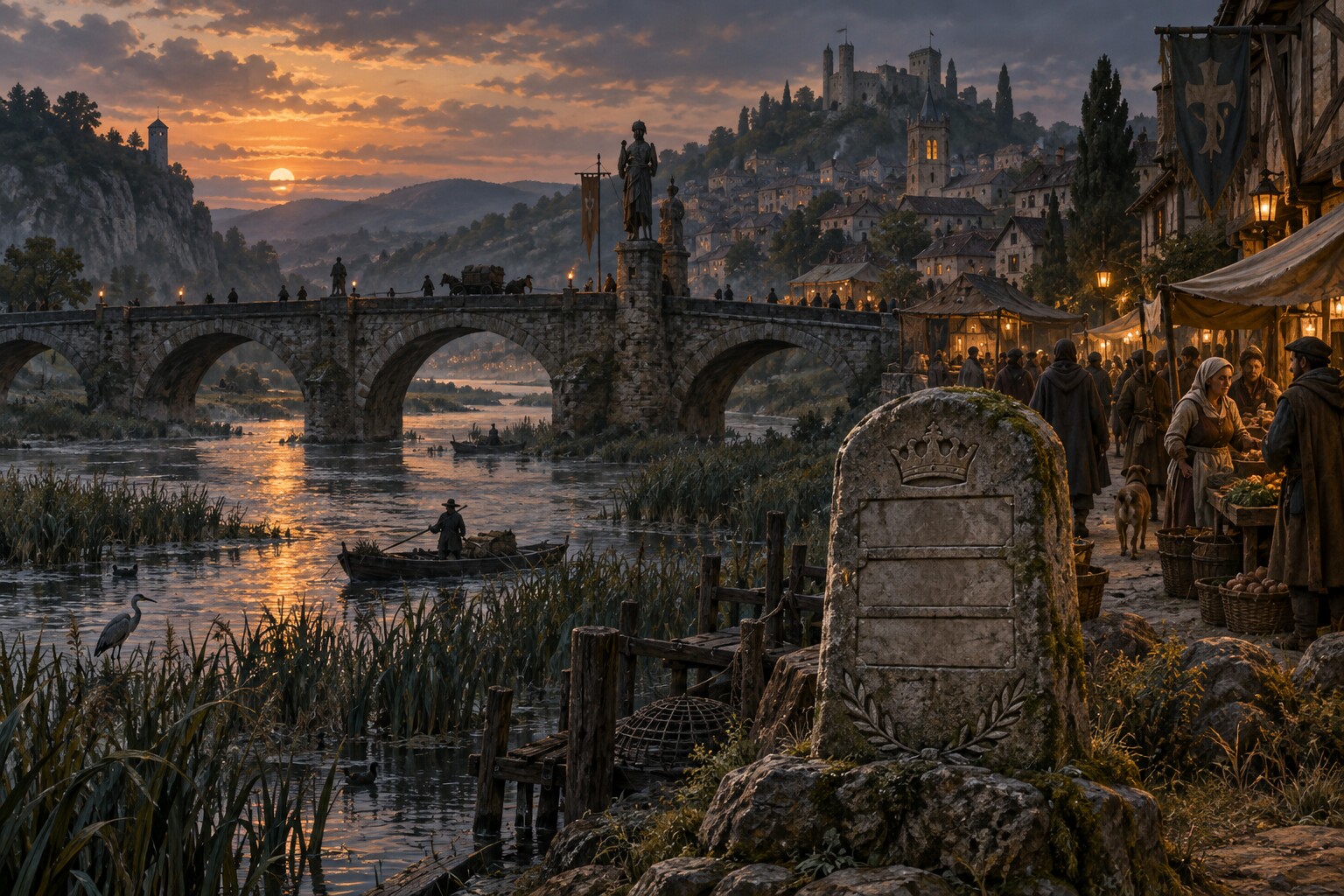
One settlement can carry three histories
You draw a bridge, place a few houses beside it, and then give the settlement one pleasant name. It works on the map. It may even sound right in a sentence. But a settlement that has lasted through floods, rulers, and ordinary mornings rarely has only one name.
Different people need different parts of its history. A traveler notices the ground and the crossing. An official repeats the name chosen by the person who claimed authority. A resident shortens the name because saying it every day is a physical act, not a ceremony.
This is not a rule that every place must have three names. It is a way to make one place feel occupied. Give each name a job, decide where it appears, and let the differences reveal who is speaking.
The exercise below uses a fictional example. The names and history were made for this article; they are not drawn from a real language or a real place.
The fictional example: Nine-Reed Ford
Imagine a wide river that spreads into nine dense beds of reed before narrowing around a low stone crossing. Boats can pass most of the year, but wagons and messengers need the bridge when the water rises. A market grows on the eastern bank. A ruler later pays for a stronger bridge and issues a charter for the settlement around it.
The place now has three names:
- Nine-Reed Ford is the terrain name. It comes from the feature that made the crossing legible before a town existed. Older maps and travelers who care about the approach use it.
- Oren's Span is the official name. Queen Oren ordered the stone bridge rebuilt after a flood and placed the settlement under a new charter. The name records her claim over the crossing. It is used in decrees, taxes, and formal introductions.
- The Span is the local short name. Residents do not need to explain which bridge they mean. The shorter form belongs to daily errands, warnings, gossip, and the market's working rhythm.
None of these names is the single correct answer. Each one preserves a different relationship with the same ground.
| Layer | Name | What it remembers | Where it belongs |
|---|---|---|---|
| Terrain | Nine-Reed Ford | The river and the crossing before the charter | Maps, travel directions, older records |
| Official | Oren's Span | The ruler's rebuilding order and claim | Decrees, tax rolls, formal speech |
| Local | The Span | The place as part of residents' ordinary life | Dialogue, market talk, warnings |
The names also create small tensions. A royal clerk may insist on Oren's Span because the charter matters to her work. A ferryman may say Nine-Reed Ford because the reeds tell him where the safe approach is. A child who has never seen nine distinct reed beds may still say The Span because that is what everyone around him says.
1. Start with the ground
Choose a feature that would remain meaningful even if the settlement disappeared for a generation. It might be a ford, a wind gap, a salt shelf, a spring, or a road cut into a cliff. Keep it observable. You do not need a secret etymology or a long invented dictionary entry.
Ask what a stranger would use to find the place. A terrain name is strongest when it points to a fact people can encounter. “Nine-Reed Ford” tells a traveler what to look for. It also leaves room for change: if the river shifts and only five reed beds remain, the old name becomes a piece of history instead of a mistake to be corrected.
2. Let authority leave a mark
Now decide whether a ruler, council, company, temple, or occupying power gave the place a formal name. The point is not to make the authority sound grand. The point is to show what that authority wanted the name to do.
Queen Oren's name is attached to the bridge because the rebuilding order was also a claim. The charter turns an old crossing into an administered settlement. In another world, the official name might commemorate a treaty, announce a new border, or replace a name that the authorities refuse to use.
Keep the reason visible in your notes. You do not need to explain the name every time it appears, but you should know which document or act made it official.
3. Listen for the name that saves breath
Residents usually optimize for shared context. They drop a word, keep the useful noun, or turn a formal name into a sound that belongs to their neighbors. The local name should not be a decorative synonym. It should be something a person could say while carrying a basket, calling across a street, or warning someone about the river.
“The Span” works because the bridge is the settlement's shared reference point. It also marks belonging. Someone who says “Oren's Span” may be visiting, filing a report, or deliberately invoking the crown. Someone who says “The Span” sounds local without having to announce it.
4. Give each name a stage
Do not scatter all three names through every paragraph. Assign each one a setting where its job is clear.
- Put the terrain name on a map, a route description, or an old traveler's account.
- Put the official name on a decree, a tax notice, a seal, or a formal introduction.
- Put the local name in a conversation where speed and shared knowledge matter.
Then test the assignment in a small scene. A courier arrives during a flood. The clerk says, “The charter road to Oren's Span is closed.” The ferryman answers, “The Span is closed until the water drops.” The courier looks at the map and asks, “Is this the old Nine-Reed Ford?” Three names have now done work: authority, daily reality, and orientation.
The scene does not need an argument about vocabulary. The choice of name is enough to show what each speaker sees.
A blank worksheet for your settlement
Fill this in without trying to make the three names equally beautiful. They should be useful in different mouths.
Terrain name
The feature a traveler would notice: ______________________________
The name shaped by that feature: _________________________________
What changed or stayed visible after the settlement grew: ___________
________________________
Official name
Who gave or enforced the formal name: _____________________________
The act, charter, conquest, or promise behind it: _________________
________________________
The official name: _______________________________________________
Local short name
What residents can omit because everyone nearby understands: _______
________________________
The short name people actually say: ______________________________
Who refuses to use it, and why: __________________________________
________________________
| Name | Speaker or group | Where it appears | History it carries | What it hides |
|---|---|---|---|---|
| __________________ | __________________ | __________________ | __________________ | __________________ |
| __________________ | __________________ | __________________ | __________________ | __________________ |
| __________________ | __________________ | __________________ | __________________ | __________________ |
The ten-second scene
What is happening at the settlement: ______________________________
________________________
Who speaks first, and which name do they use: _____________________
________________________
What the other person calls the same place: _______________________
________________________
If the scene feels too tidy, keep one mismatch. A resident can use the official name sarcastically. A map can preserve a terrain name that no longer describes the river. An outsider can use the local short name correctly and still reveal that they learned it from someone else. Names become story when their use has a cost or a consequence.
Carry the decision into the world
The useful result is not a list of synonyms. It is a small record of who sees the settlement, what they need from it, and which history they are willing to carry in public. Once those choices exist, you can use them to guide a scene, a map label, or a piece of world reference material.
For a broader look at how meaning and sound can work together, see Who Named It, and When — A Two-Layer Method for Place and Person Names. For this three-layer exercise, you can create a world in Worldseed, discuss the settlement with the AI, and add only the suggestions you choose to keep. The draft is not canon until you make that choice.
Carry it into your world
Turn one idea from this article into a living part of your world
Name the world, choose a genre, and use AI to connect your first element to the rest of the setting.
This week's seed: “Magic works only when spoken aloud in front of a witness. Who becomes valuable in this world — and who is silenced?”
Free includes 20 AI messages per 24 hours. No card required.
Keep shaping the idea
Three guides connected by topic, craft, or worldbuilding method.
A Faction That Outlives Its Founder
A practical worldbuilding exercise for making an organization continue after its founder is gone: define the work, shared resource, succession choice, and internal conflict. Includes a blank organization card.
Read guide →The Market That Tests Your Fantasy Map
A practical map exercise for giving a border market a reason to exist: what moves through it, when its road closes, who controls passage, and what a detour costs. Includes a blank market card.
Read guide →Your Map Passed the River Check and Still Feels Fake
The river police are right about rivers — and that is only half the job. How to audit a fantasy map in the right order, with a five-column settlement audit that turns geography into political history.
Read guide →