A Faction That Outlives Its Founder
A practical worldbuilding exercise for making an organization continue after its founder is gone: define the work, shared resource, succession choice, and internal conflict. Includes a blank organization card.
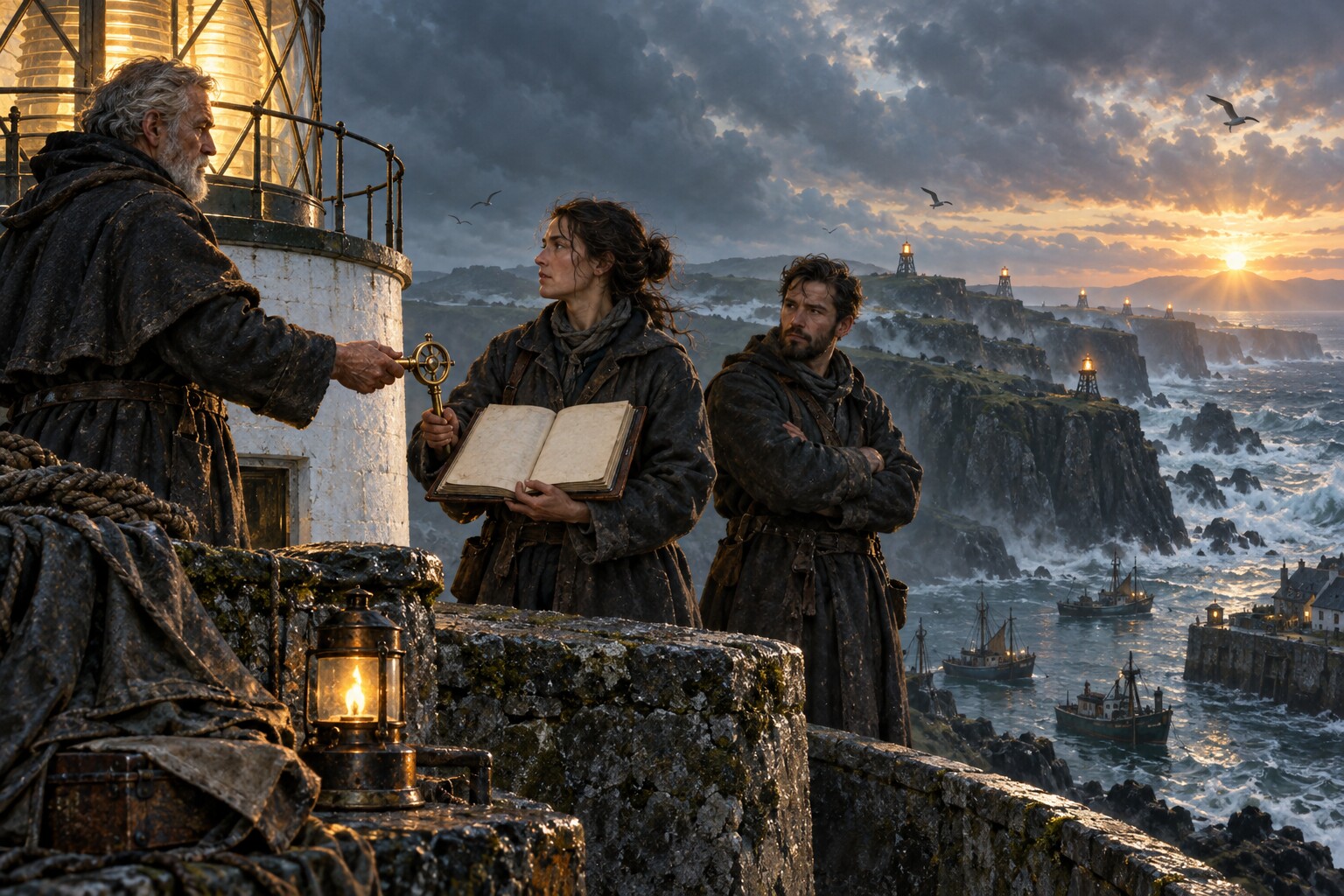
A founder is not the faction
Many fictional organizations begin with one compelling person. The founder has the vision, the scar, the secret, or the map. Everyone else is introduced as a follower. Then the story asks the natural question: what happens when the founder is gone?
If the answer is “the organization disappears,” that may be exactly what you want. But if the faction is meant to outlive its founder, a list of additional names is not enough. Someone must still do the work. Something must still be shared. A successor must be chosen, and people inside the group must have reasons to disagree.
This exercise uses a fictional lighthouse keepers' guild. The example was made for this article and is not based on a real organization or political group. Use it to give your own faction a job that continues even when its most famous member no longer gives orders.
The fictional example: the Lantern Wardens of Breakwater Reach
Breakwater Reach is a dangerous coast where fog can swallow a boat before the crew sees the rocks. The Lantern Wardens maintain a chain of lighthouses and shore signals. Their founder, Iven Marr, built the first tower and persuaded three villages to share its lamps.
The Wardens survive Iven because their identity is anchored in four practical things:
- Necessary work: each dawn, someone checks the lens alignment, trims the wick, records the weather, and tests the signal bell. Ships do not care whether Iven is alive; they still need the light.
- Shared resource: every tower depends on a sealed store of lamp oil and replacement glass. The store is held in common, so no single keeper can keep the whole chain operating alone.
- Succession choice: Iven left the master key to the senior apprentice, but the Wardens must confirm a new keeper at the winter gathering. Skill, trust, and knowledge of the whole coast matter more than being Iven's favorite.
- Internal conflict: one group wants the oil reserved for the largest harbor, while another insists that the smaller outer lights are what keep local boats alive. Both sides are protecting the guild's work; they disagree about whose risk counts first.
The founder gave the Wardens a beginning. These four structures give them a next morning.
| Part of the faction | The Lantern Wardens' example | Question it answers |
|---|---|---|
| Necessary work | Maintain lenses, wicks, weather records, and shore signals | What must happen even during grief? |
| Shared resource | A sealed common store of lamp oil and replacement glass | What can no member safely own alone? |
| Succession choice | The senior apprentice holds the key until the winter confirmation | How is authority transferred? |
| Internal conflict | Harbor reserve versus outer-light coverage | What do loyal members disagree about? |
Notice what is missing: a claim that the Wardens are united. Their continuity comes from a task and a resource, not from perfect agreement. Conflict gives the remaining members something to negotiate after the founder's death.
1. Give the group work that resists symbolism
Start with a task that produces a consequence when it is neglected. “Protect the old ways” can be part of a faction's self-description, but it does not tell us what a member does on a wet morning.
The Wardens have to clean lenses, test bells, and record weather because a missed task changes what ships can see. Other factions might repair a canal, authenticate names in a family archive, keep a dangerous road open, or carry messages between settlements. The work can be humble. Its effect should be legible.
Ask what happens if the founder cannot perform the task for one week. Who notices first? What breaks? The answer identifies the people who were already carrying the faction before the story paid attention to them.
2. Put a resource in the middle
A shared resource is more useful than a shared slogan. It creates cooperation, accounting, and the possibility of unfairness.
For the Wardens, lamp oil and replacement glass bind distant towers together. A keeper at the central harbor may control the warehouse, but an outer tower can still argue that the supplies belong to everyone. The resource also makes the faction vulnerable: a locked store, a delayed shipment, or a damaged inventory book can change the balance of power without anyone giving a speech.
Choose something the members need to exchange. It could be a tool, a route, a trained animal, a protected archive, a ritual material, or the right to use a piece of infrastructure. Then decide who counts it, who repairs it, and who is accused of taking too much.
3. Make succession a choice, not a bloodline shortcut
The successor should inherit a problem as well as a title. If the founder's child automatically takes control, ask what the other members are expected to do with their knowledge and doubt.
Iven Marr's senior apprentice holds the master key, but that does not settle the succession. The winter confirmation creates a narrow opening for the rest of the guild to ask whether the apprentice understands the outer lights, can allocate the common store, and can listen to a keeper who disagrees.
You can make the transfer formal, improvised, or contested. The important part is to show what the group considers evidence of fitness. Is it technical skill, a record of service, the ability to mediate, a promise to preserve a secret, or willingness to take the unpopular shift?
4. Give loyal members a real disagreement
Internal conflict is not proof that the faction is badly designed. It is evidence that members are making choices under pressure.
The Wardens' harbor faction wants a reserve because the largest port supports the most ships. The outer-light faction sees the same reserve as a threat: a small boat may have fewer witnesses, but its crew still depends on the light. Neither side has to be secretly evil. Their disagreement can be about scale, duty, memory, or which loss the founder would have accepted.
Keep the conflict attached to the four practical parts of the faction. Who gets the resource? Which work is called essential? What does the succession process reward? When the group says it is preserving the founder's purpose, which version of that purpose does each side mean?
The founder-gone test
Write a small scene set on the first difficult morning after the founder's death. Do not begin with a memorial. Begin with the work.
At Breakwater Reach, a storm arrives before dawn. The central tower has enough oil for one full night and the outer lights have enough for only half a night. The master key is in the apprentice's hand. A keeper from the harbor says to protect the shipping lane. A keeper from the outer cliffs says the local boats will be trapped without their light.
The scene can answer four questions without explaining the entire history:
- Who knows how to do the necessary work?
- Who controls or counts the shared resource?
- What does the succession rule permit right now?
- What does each side fear will be lost?
If the faction can act, argue, and make a mistake without the founder appearing to solve the problem, it has a life of its own. If everyone waits for an absent voice, decide whether that dependence is the point of the story or a gap in the design.
A blank organization card
Fill this with concrete nouns and actions. Leave one answer imperfect if the uncertainty can become a source of conflict.
Necessary work
The task the faction must perform: ________________________________
________________________
What changes when the task is missed: _____________________________
________________________
Shared resource
The thing members need to share: _________________________________
Who stores, repairs, or counts it: _________________________________
________________________
Succession choice
Who can take responsibility after the founder: ____________________
What evidence or ritual confirms the choice: ______________________
________________________
Internal conflict
The issue loyal members cannot agree on: __________________________
________________________
What each side believes it is protecting: _________________________
________________________
| Organization card | Your answer | Evidence in a scene |
|---|---|---|
| Necessary work | __________________ | __________________ |
| Shared resource | __________________ | __________________ |
| Succession choice | __________________ | __________________ |
| Internal conflict | __________________ | __________________ |
The morning after
What must happen before midday: __________________________________
________________________
Who acts without waiting for the founder: _________________________
________________________
What decision leaves a new disagreement behind: ___________________
________________________
Do not make the group timeless. Let it inherit habits, damage, and unfinished arguments. A faction that outlives its founder should still be able to change, because continuity is more interesting when it has to be maintained by people who remember the beginning differently.
Carry the faction into your world
The goal is a group that can do something tomorrow, share something today, transfer responsibility, and disagree while remaining recognizable. Those details give you material for scenes and world reference pages without turning the faction into a biography of one important person.
In Worldseed, you can create a world, discuss the organization with the AI, and add only the suggestions you choose to keep. Treat the AI response as a draft; the add control is where you decide what becomes part of your saved world.
Carry it into your world
Turn one idea from this article into a living part of your world
Name the world, choose a genre, and use AI to connect your first element to the rest of the setting.
This week's seed: “Magic works only when spoken aloud in front of a witness. Who becomes valuable in this world — and who is silenced?”
Free includes 20 AI messages per 24 hours. No card required.
Keep shaping the idea
Three guides connected by topic, craft, or worldbuilding method.
Three Stories Behind a Settlement Name
A practical worldbuilding exercise for giving one settlement three useful names: the terrain name, the ruler's official name, and the short name residents actually say. Includes a blank worksheet.
Read guide →5 Principles for Designing a Magic System Without Plot Holes
Five principles for building a coherent magic system: establishing costs and constraints, connecting to physical laws, considering social impact, using symmetry and contrast, and leaving room for discovery.
Read guide →Species Design Fundamentals — How to Create Believable Fantasy Races
A guide to designing original fantasy species with internal logic: starting from ecology, building culture from survival strategy, language shaping thought, lifespan differences, sensory variation, and social structure.
Read guide →