Who Named It, and When — A Two-Layer Method for Place and Person Names
Two pieces of naming advice contradict each other. Real place names (-chester, -by, Ainu -nai) settle the argument: names have a meaning layer and a form layer. Includes a three-column naming ledger you can use tonight.
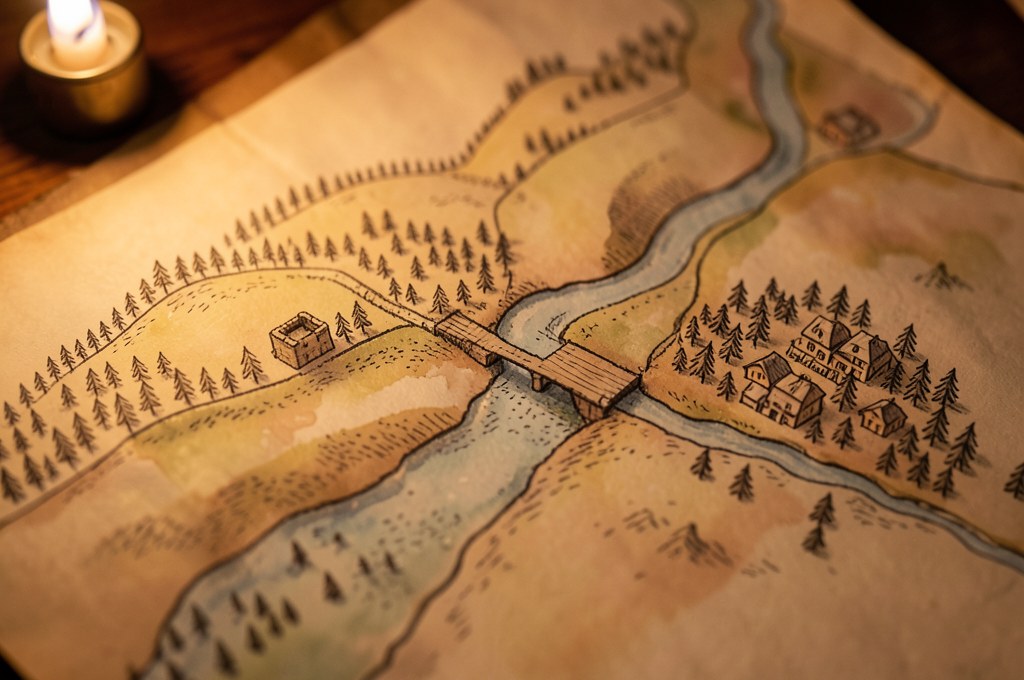
You finish the map, you go to name the towns, and your hand stops. The terrain is settled, the history is settled, and yet the names keep coming out as pleasant-sounding noise that makes the whole world look cheap the moment you write them down.
What makes it worse is that the advice splits in half. One camp says work on the form of the name. The other says never choose by sound — derive the name from what happened there. This piece settles the argument with a third witness: real place names. Both camps turn out to be right. They are simply looking at different layers.
Two writers, saying opposite things
Kurosaki (黒崎江治), who writes craft essays for TRPG and fiction, argues in "Inconvenient personal names in high fantasy" (Japanese) that names carry a cost to the reader. When "Lucan," "Rodan" and "Sarman" sit side by side, it "takes cognitive effort to tell the characters apart from the letters alone" — it may drain the reader's attention, as he puts it. Borrow a real name and the real referent comes with it: Arthur, Friedrich and Nobunaga all arrive pre-loaded. The remedy he applied in his own work was to vary the presence and position of long vowels and the number of characters, so that similar names stop blurring.
What he called "a little mismatched" was a published novel in which a sister and brother of the same house are named Julia (Roman) and Hector (Greek), while the family name itself reads German. His conclusion follows from that: for characters from the same country, it is safer to keep the language of origin consistent. His scope is personal names within one family and one country.
The other essay, "Thinking about a better way to name places in fantasy" by Jagaimo Tantei on the Japanese fiction platform Shōsetsuka ni Narō, rejects sound as a starting point entirely. Decide first what was there: a mountain, a forest, a river, a particular resource. Then decide who held the most influence over that land, and what they came for. A town where trout are caught becomes Trouton; a fort on rock becomes Fortock; the village of a headman named Harry becomes Harryville, and once it is chartered as a burgh, Harrisburgh. The author adds a caution: "sometimes simpler is better."
One says shape the form. One says start from meaning. Standing over your own map, it is not obvious which to obey.
Real place names are built in two layers
Open an actual atlas and the argument dissolves.
Look at English place-name endings. -ton is Old English for a fenced enclosure or farmstead, -ham for a homestead. -chester / -caster / -cester descend from Latin castrum, a military fort, and mark places with Roman remains. -by is Old Norse for a village, and it clusters across the Danelaw, where Viking rule held (Toponymy of England). Derby is the textbook -by: a Norse settlement name, though a derivation from the Roman Derventio has also been proposed.
The same thing happens in northern Japan. An unusual number of Hokkaido place names end in -nai (a stream) or -betsu (a river), both from Ainu; Wakkanai is generally traced to yam-wakka-nai, "the stream of cold drinking water."
So a place name has two layers: the meaning layer (what was there) and the form layer (whose language named it, and what spelling and sound that produced). The Narō author is describing the meaning layer; Kurosaki is working on the form layer. They were never in conflict. Hold only one and you get either a world whose names all have reasons but no coherence, or a world that looks beautiful and means nothing.
Match up close, diverge at distance
Here is my own read. Kurosaki's "keep the language of origin consistent" is right within his scope — personal names inside one family and one country. If a sister and a brother carry a Roman and a Greek name, the reader's first thought is that something happened in that household.
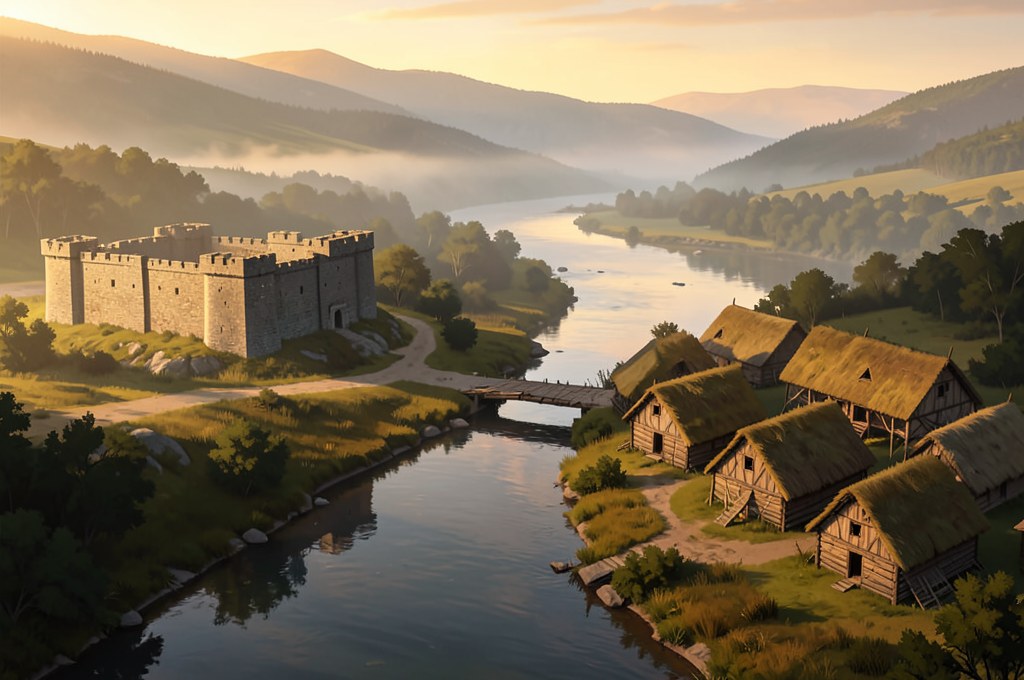
But extend the same rule across the whole map and the world flattens into a single people. England is not unified. Roman, Anglo-Saxon and Norse names sit on the same island without embarrassment, and nobody calls the map mismatched. What grates is not the mixture but a mixture with no cause behind it. If two neighboring villages sound German and Greek because that is the order the ideas arrived in the author's head, readers feel it. If everything north of the river carries the conqueror's tongue and everything south carries the older one, the same unevenness becomes history written into the map.
Match up close, diverge at distance. That asymmetry is what makes one family and one country feel real at the same time.
Tolkien is the extreme case of building the form layer first — he wrote that "the stories were made rather to provide a world for the languages than the reverse" (Letters, no. 165). What made him unusual was constructing entire languages. You do not need to. You need the relationship between the two layers.
Something to take away: the naming ledger
Every time you invent a name, fill in three columns. A spreadsheet works; so does a page in your world.
| Name | Meaning layer (what was there / who) | Form layer (whose language, when) |
|---|---|---|
| Trouton | A ford on a river where trout run | Current ruling tongue, ~300 years ago |
| Cairn Vad | A shallow crossing marked by stacked stones | Pre-conquest people, oldest layer |
| Eastgate Row | The road to the eastern gate of the wall | Current ruling tongue, recent |
Fill it right to left. First fix three language groups for the world — the old or conquered layer, the current rulers, and traders from outside. That turns the form layer into a multiple-choice question. Then fill the middle column: terrain, structure, person or product. Anchoring there is what keeps the Narō author's "sometimes simpler is better" honest. The name itself comes last.
When I borrow a real word I hold myself to something tighter than Kurosaki's own examples (Jacqueline into Jackline, Galahad into Gaelzad): change exactly one consonant or one vowel. Change more and it becomes unreadable; change less and the real referent walks in behind it.

For personal names, the meaning layer holds "attached to whom"
Personal names fit the same ledger, but the meaning layer holds something different. Where a place name records what was there, a personal name records who the person is attached to. Real languages are remarkably literal about this: Norse -son and -dóttir (still living as true patronymics in Iceland and a few other places), Russian -ovich and Arabic ibn all carry "child of" inside the name. Trades became surnames just as readily — Smith, Baker. And Leonardo's "da Vinci" is not even a surname; it means "from the town of Vinci."
So before naming anyone, decide one thing for the culture: what does it use to identify a person? The father, the clan, the birthplace, the trade. Settle that and naming secondary characters becomes fast. It also dissolves Kurosaki's blur problem, which bites hardest when a world has only one kind of identifier — put a clan-name people and a patronymic people in the same cast and readers will keep them apart even when the forms are close.
Three ways this goes wrong
- Treating every name as precious. Nine names in ten appear once. Keep a ledger only for the ones a reader will meet twice.
- Making names nobody can pronounce. An unsayable name is an unremembered name, and it drives Kurosaki's cognitive cost straight up. Read your consonant clusters aloud before you commit.
- Keeping the ledger somewhere other than the world. I have lost my own naming logic twice, once to a spreadsheet and once to a private wiki. Three months later you will not remember why the town is called that. Store the reason next to the name.
Tonight, just three
Pick three place names from your world and fill in only the middle column. Giving a reason after the fact to a name you originally chose by ear is more fun than it sounds — and the moment the reason exists, the next piece of history in that region starts growing on its own.
In Worldseed you can record these naming reasons as elements of your world and expand them into local history through conversation with an AI. Start by giving your world's names a reason.
For a hands-on follow-up, use Three Stories Behind a Settlement Name to give one settlement a terrain name, an official name, and a name residents actually say.
Carry it into your world
Turn one idea from this article into a living part of your world
Name the world, choose a genre, and use AI to connect your first element to the rest of the setting.
This week's seed: “Magic works only when spoken aloud in front of a witness. Who becomes valuable in this world — and who is silenced?”
Free includes 20 AI messages per 24 hours. No card required.
Keep shaping the idea
Three guides connected by topic, craft, or worldbuilding method.
Three Stories Behind a Settlement Name
A practical worldbuilding exercise for giving one settlement three useful names: the terrain name, the ruler's official name, and the short name residents actually say. Includes a blank worksheet.
Read guide →A Faction That Outlives Its Founder
A practical worldbuilding exercise for making an organization continue after its founder is gone: define the work, shared resource, succession choice, and internal conflict. Includes a blank organization card.
Read guide →From Idea to Canon: One Place, Three Decisions
A practical worldbuilding loop for separating AI suggestions, your revisions, and the setting you actually keep. Use a night harbor example and a Keep/Change/Leave open worksheet to turn one idea into usable canon.
Read guide →