The Market That Tests Your Fantasy Map
A practical map exercise for giving a border market a reason to exist: what moves through it, when its road closes, who controls passage, and what a detour costs. Includes a blank market card.
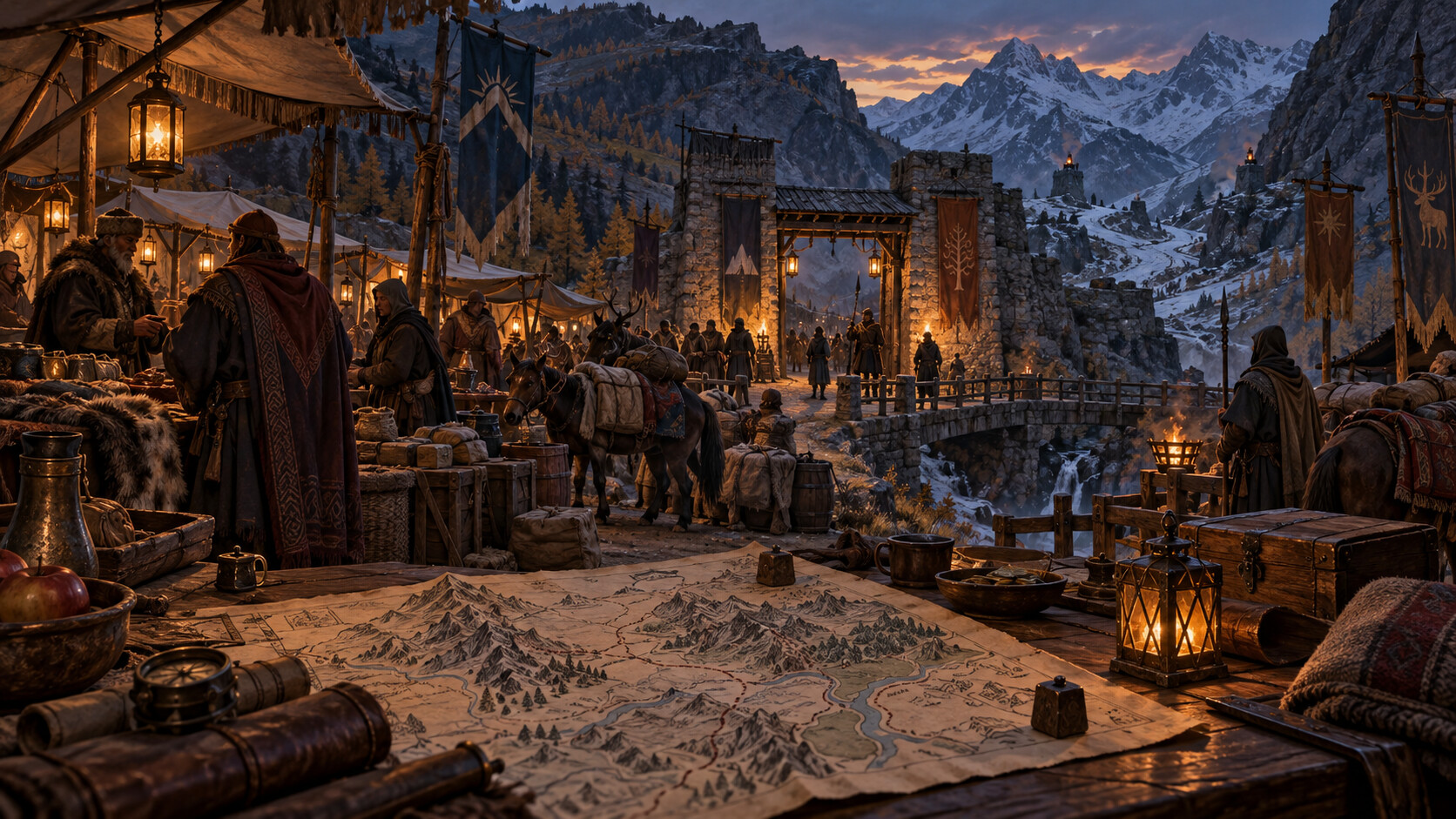
You add a market to the map because the space between two regions looks empty. You draw stalls, a gate, and a road through the pass. The market is attractive, but when you ask why anyone travels there, the answer is only “because a market belongs here.”
That is the moment to stop drawing and test the place.
A border market does not need a grand founding myth. It needs a pressure that makes people arrive, a season that changes the route, a person or group that can allow or deny passage, and a cost for going around. Those four questions turn a decorative dot into a place that can affect a story.
The market in this article is fictional. Glass-Root Market, its road, its traders, and every detail in the examples were invented for this exercise. The method is not a claim about any real city, trade route, or historical border.
A border is a question, not a line
Begin with a simple map condition:
> Two regions need one another’s goods, but the easiest crossing between them is controlled by a pass that becomes unreliable each winter.
The condition creates a reason for contact without deciding the whole political history. On one side of the pass, the valley grows dye plants. On the other, the high country produces salt blocks. Both goods are useful in the other region, but neither side can carry enough by the longer road once snow reaches the upper trail.
Place Glass-Root Market where the road narrows beside a bridge. The market is not there because the map needs a symbol. It is there because people moving goods need a place to exchange loads, wait for an escort, and learn whether the pass is open.
The four questions below are the market’s first test. Answer them in order, but keep the answers small enough to change.
Question one: what must move through the market?
“People trade here” is too broad to generate a scene. Name one thing that enters, one thing that leaves, and one reason the exchange cannot happen just anywhere.
At Glass-Root Market:
- Dye cakes arrive from the low valley.
- Salt blocks leave for the workshops below.
- The bridge is the last place where loaded carts from either side can be weighed and repacked before the steep trail.
The goods do not need to be rare. They need to create a dependency. If both sides can make the same thing, the market may still exist, but you will need another reason for people to choose this crossing.
Write the exchange as a sentence:
> The market exists because A must reach B, and the crossing lets them change C before the route becomes difficult.
For Glass-Root, dye must reach salt workshops, the high trail makes carts unstable, and the bridge lets crews split one heavy load into smaller packs. The physical detail is doing economic work. It tells you why carriers stop here instead of continuing until the next town.
Question two: when does the road close?
Do not treat the season as scenery. A closure changes the market’s inventory, prices, labor, and mood. It also gives the map a clock.
The high trail to Glass-Root closes when the first three nights of hard frost make the rope bridge unsafe. That does not mean the whole region becomes unreachable. A lower detour remains open, but it takes six days instead of one and requires a guide who knows the river flats.
Now the market has two versions:
| Season | What the market does |
|---|---|
| Open trail | It handles exchange, weighing, repairs, and route news |
| Closed trail | It stores salt, hires flatland guides, and sells information about the lower detour |
The exact number of days is an invented value for the example, not a universal rule. Change it if your map needs a different rhythm. The useful part is the contrast: a road that closes must leave a trace in what the market does next.
Ask what the closure changes for an ordinary person. A carrier may have to choose between waiting beside the gate and paying for a guide. A workshop may ration salt. An inn may fill with travelers who expected to cross before the frost. The map begins to produce decisions.
Question three: who allows passage?
A border market is not only a collection of sellers. Someone decides whether a person, caravan, message, or animal can cross the bridge. That authority can be official, inherited, rented, or contested.
At Glass-Root, the bridge is maintained by the Pass Ledger House, a small office funded by a charge on each loaded cart. The Ledger House issues a clay seal for the crossing. Its clerks are not kings and do not own the pass. They control the practical act that makes the route usable: inspecting the load and opening the gate.
That arrangement gives several groups a reason to care:
- The valley growers want the fee low enough that dye remains worth carrying.
- The highland workshops want the bridge repaired before the frost.
- The Ledger House wants every cart recorded because its income depends on the crossing charge.
- Smugglers want an alternate path that does not produce a seal.
The controlling group should have work to do beyond saying no. It might repair a bridge, settle a dispute about a damaged load, publish a closure signal, or keep a list of people who owe a fee. Mundane responsibility makes authority visible.
Do not make the controller automatically evil. A group can be competent and still create a problem for someone who cannot pay. It can protect the route and still use the records to favor one side. A practical power is more useful than a label.
Question four: what does the detour cost?
The detour is where the market’s importance becomes measurable. If the main route closes and the alternative costs nothing, the border is only decoration. Give the detour a cost that changes a decision.
For Glass-Root, the lower road costs three things:
- Time: the journey takes several extra days, so perishable dye loses value.
- Labor: a local guide must be hired, and the guide may refuse an unfamiliar caravan.
- Exposure: the lower road passes through flood flats where a load can be damaged and a traveler can be seen from the riverbank.
The cost does not have to be money. It can be a lost festival, a missed appointment, a political favor, or the risk of revealing a route. Choose the cost that makes sense for the people using your map.
Once the detour has a cost, the market can create pressure without a battle. A merchant may cross the unsafe pass early. A clerk may falsify a date on a seal. A family may sell a tool to afford the guide. A rival settlement may offer a cheaper route and try to draw the traffic away.
The market card: one row before a whole region
Put the four answers on one card. This is a worked example, not a template for every market:
| What moves through it? | When does the road close? | Who allows passage? | What does the detour cost? |
|---|---|---|---|
| Dye cakes go uphill; salt blocks go down; loads are repacked at the bridge | The high trail closes after hard frost makes the rope bridge unsafe | The Pass Ledger House inspects carts and opens the gate for a crossing fee | The lower road takes days, needs a guide, and exposes cargo to flood damage |
The four cells reinforce one another. The goods explain the stop. The season changes the service. The controller has a job. The detour gives the closure consequences.
Now fill the blank card for your own map. Leave a cell empty if the answer is not ready; an honest unknown is easier to use than a decorative answer you will contradict later.
| What moves through it? | When does the road close? | Who allows passage? | What does the detour cost? |
|---|---|---|---|
Use one row for one market or crossing. If you have a second route, give it a second row instead of putting two incompatible answers in one cell.
Turn the card into a scene
The market becomes part of the world when a person must act because one of the four answers is true.
Here is a short scene from Glass-Root:
> On the first frost morning, Neri reaches the gate with six dye crates and a travel seal dated yesterday. The Ledger clerk points to the bridge rope, already rimed white, and refuses the crossing. Neri can wait three days for a repair crew, pay for a guide down the flood road, or sell the crates to a highland broker at the market’s reduced winter price. Behind Neri, a workshop courier is arguing that salt is already running out. The gate is closed to carts, but the market has never been busier.
The scene does not need a map lecture. It shows the goods, the seasonal closure, the controller, and the detour cost through one decision. If you removed any one of the four answers, the choice would change.
Try writing your own scene with these constraints:
- One person arrives with something the market needs.
- One route condition blocks the easiest choice.
- The gatekeeper or controlling group makes a practical decision.
- The detour costs something the person cannot ignore.
That is enough. You can add history after the market has done one piece of work in the present.
Rivers and mountains are tools, not verdicts
A map guide can help you notice physical pressure, but geography should not become a set of absolute prohibitions. A river that forks may be an error, or it may be an intentional result of engineering, flooding, magic, or a different terrain. A mountain pass may be improbable, or it may be the reason a settlement exists.
The question is not “is this shape allowed?” The question is “what does this shape force someone to do?” If your exception has no consequence, it may be a leftover drawing. If it creates a dependency, a cost, or a contested opportunity, it is part of the world’s causal structure.
The fantasy map audit is a useful companion for checking physical flow and settlement purpose. This market card starts where the audit ends: with the people who need to use the route.
Move one card into Worldseed
Worldseed lets you explore this kind of map question in conversation without making every suggestion permanent. Start with one crossing and ask for a candidate market. Read the result as a possibility, then ask for one narrow change: keep the goods and location, but change who controls passage; keep the gatekeeper, but change the cost of the detour.
Recent successful exchanges can continue while you remain in the same chat. An unsaved proposal is not a permanent setting entry: if you leave or reload, that conversation or proposal may no longer be available. The Add action is the author’s decision to save the selected element. Keep your market card beside the chat so the saved element records the consequence you chose rather than every possibility the conversation produced.
Use this small sequence:
- Name one border and one thing that must cross it.
- Ask for one market with a seasonal closure.
- Decide who controls passage and what work that authority performs.
- Fill in the detour cost and write one scene.
- Use Add only after the card describes the version you want to keep.
The Free plan currently allows 20 AI messages per rolling 24 hours, and no card is required to begin. One market card is a complete session-sized exercise; you do not need to generate an entire trade network before testing one route.
Give one market a reason to be on the map
Open your map and circle one place that exists mainly because the composition looks balanced. Ask the four questions. If the answers are weak, move the market, combine it with a crossing, or give it a different job. The map is allowed to change when the consequences reveal a better location.
When one person has a reason to arrive, one group has a reason to control the gate, and one detour hurts enough to change a decision, your market has earned its place. Draw the next road only after this one starts making trouble.
Carry it into your world
Turn one idea from this article into a living part of your world
Name the world, choose a genre, and use AI to connect your first element to the rest of the setting.
This week's seed: “Magic works only when spoken aloud in front of a witness. Who becomes valuable in this world — and who is silenced?”
Free includes 20 AI messages per 24 hours. No card required.
Keep shaping the idea
Three guides connected by topic, craft, or worldbuilding method.
Your Map Passed the River Check and Still Feels Fake
The river police are right about rivers — and that is only half the job. How to audit a fantasy map in the right order, with a five-column settlement audit that turns geography into political history.
Read guide →Three Stories Behind a Settlement Name
A practical worldbuilding exercise for giving one settlement three useful names: the terrain name, the ruler's official name, and the short name residents actually say. Includes a blank worksheet.
Read guide →A Faction That Outlives Its Founder
A practical worldbuilding exercise for making an organization continue after its founder is gone: define the work, shared resource, succession choice, and internal conflict. Includes a blank organization card.
Read guide →