When Messages Travel Faster Than Ships: An Alternate-History Consequence Ledger
A practical alternate-history exercise for tracing one changed technology into the organization that controls it, ordinary work and travel, and a scene a reader can witness. Includes a four-column consequence ledger.
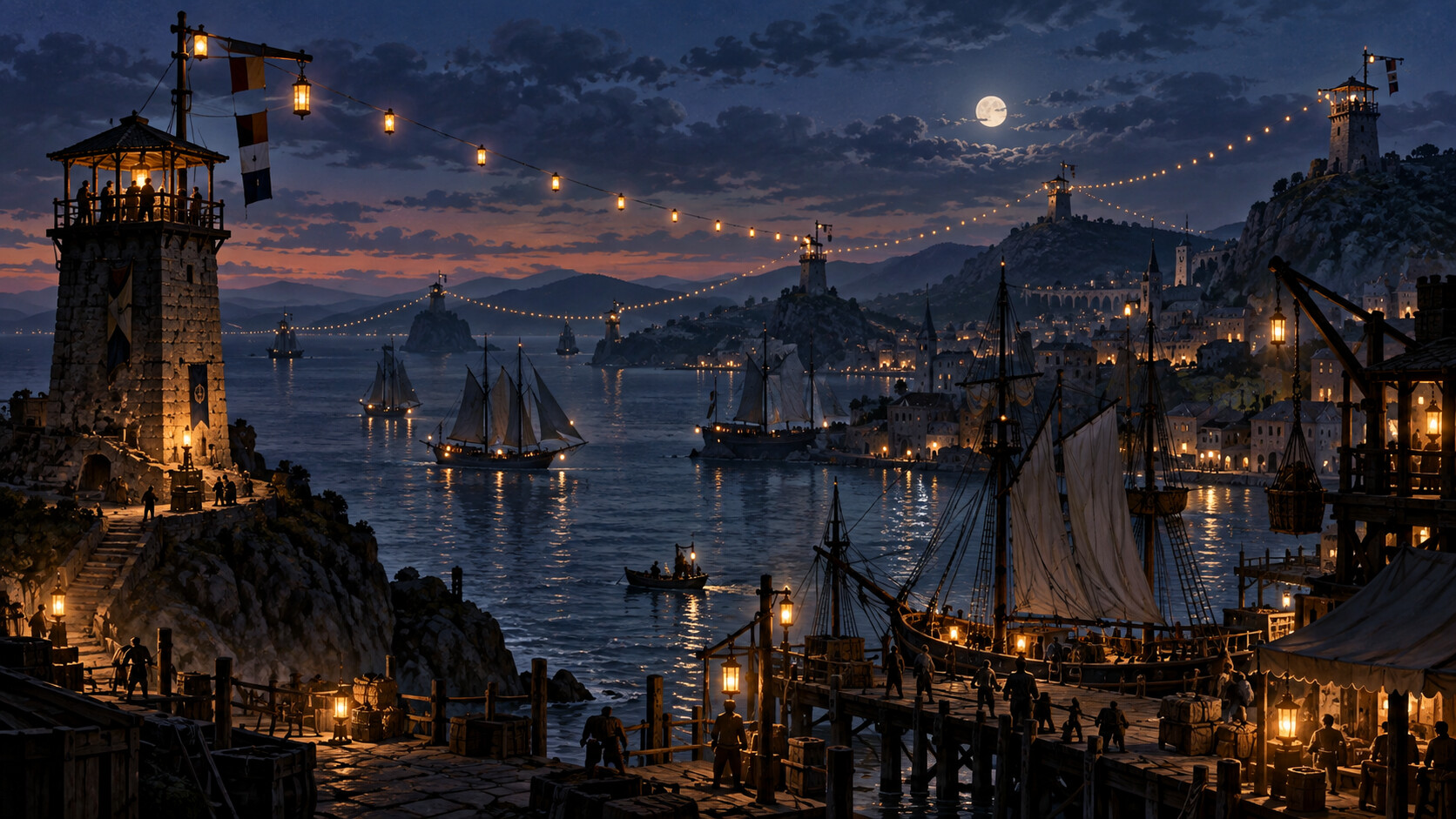
You can draw a convincing branch in a timeline and still end up with a world that feels exactly like the one you started with. The new king has a different name, the treaty has a different date, and the map has a different border. Yet the people still work, travel, buy food, and argue in the same way.
That usually means the divergence stopped at the technology or event. It never reached the organization that could use it, the ordinary routines it would change, or a person standing inside the result.
This exercise follows one fictional branch: a coastal society develops reliable long-distance communication before it develops steamships. The port, the signal system, and every person in the examples were invented for this article. This is not a claim about real history, and it is not a test of whether you can guess the right timeline. The point is to make one changed condition touch the ground.
Start with the branch, not the whole world
An alternate history becomes manageable when the point of divergence is small enough to state in one breath. Do not begin with “rewrite the next three centuries.” Begin with a changed capability.
> Long-distance messages can cross the coast in a few hours, but ships still travel at the old sailing speed.
The sentence leaves useful things unchanged. Boats still need wind, cargo still waits at docks, and a person still has to decide what a message means. The new capability is important because it changes the order in which information and material can move.
Call the fictional port Brineglass. It sits on a difficult bay where several sailing routes meet. Before the branch, a warning or price change travelled only as fast as the next boat. After the branch, a chain of relay towers can carry a message from one headland to another before a loaded ship reaches the next harbor.
Do not add a continent-wide empire yet. First ask what this one advantage forces people to invent around it.
The four questions that make a branch real
Use one row for one consequence. Move across the row in order. The changed technology is only the start; the last column is where a reader can see the result.
| Changed technology | Organization that controls it | Work, travel, and everyday objects | A scene where the chain is visible |
|---|---|---|---|
| Relay glass carries a short message between coastal towers in hours | The Brineglass Signal Office licenses tower keepers and records every dispatch | Harbor clerks sell message slots; sailing schedules change before cargo does; households keep a reply slate by the door | A dockmaster closes a gate after receiving a storm warning while a ship is still visible beyond the reef |
The row works because each box answers the next question. If the message travels quickly, someone controls the channel. If someone controls the channel, jobs and access rules appear. If work and travel change, a person eventually has to act differently in a specific place.
The example remains deliberately small. The Signal Office may later become corrupt, split into rival branches, or lose control to a group that owns the glass. You do not need that history before you know what a clerk does at noon.
Technology is a pressure, not a miracle
Name the new capability without giving it unlimited reach. A useful branch has edges:
- The relay glass carries words, not people or cargo.
- Each tower needs a trained operator and a clear line to the next tower.
- Long messages require several relays and cost more.
- A storm can interrupt a route without sinking any ship.
These limits are not an attempt to make the invention scientific. They give the world something to organize around. The Signal Office can charge by distance. A rival port can build a tower on a dangerous cliff. A sailor can arrive with the correct cargo and the wrong information because the message stopped at the last relay.
Write the limit beside the invention. If you cannot name what the technology fails to do, you are likely writing a power rather than a cause.
The organization appears next
The branch is not complete when the invention exists. Ask who can make it useful at scale and who can deny access.
In Brineglass, the Signal Office begins as a public harbor desk. It assigns tower keepers, checks the sequence of lamp flashes, and keeps a written dispatch register. As the network becomes valuable, three groups depend on it differently:
- The harbor authority wants storm warnings and dock instructions to arrive first.
- Merchants want early prices and route news, but do not want competitors to read them.
- Sailors and households want affordable messages that are not treated as commercial traffic.
You do not need to decide which group is morally right. Decide who has a practical reason to pay, who has a reason to bypass the office, and who can be harmed when a message is delayed or altered.
The controlling organization should also have a mundane job. The Signal Office does not merely “hold power”; it replaces broken lenses, trains night operators, settles queue disputes, and decides whether a message is urgent enough to interrupt a scheduled relay. Those tasks are where the institution becomes believable.
Follow the branch into ordinary life
The strongest consequence is often not a revolution. It is a small change in what people carry, when they leave, and what work counts as skilled.
For Brineglass, the ledger might continue like this:
| Changed technology | Organization that controls it | Work, travel, and everyday objects | A scene where the chain is visible |
|---|---|---|---|
| Relay glass makes arrival notices reliable before a ship docks | Signal Office and licensed message brokers | Brokers sell arrival windows; inns reserve rooms from tower reports; families keep a small fee pouch for replies | An innkeeper turns away a traveler because the tower has already reported that their ship missed the tide |
| A dispatch can be copied at each relay | Signal Office examiners and private code houses | Copyists become a respected trade; merchants use sealed message tubes; public notices are written for people who cannot pay for private code | A copyist notices that one word changed between towers and refuses to certify the invoice |
| Night relays work along the main headlands | Harbor authority and watch captains | Night watch becomes a communication shift; sailors plan departure around signal windows; lamps become household status objects | A child watches the tower lights and realizes that the family boat will not return before morning |
Notice what did not change. A ship still carries timber slowly. A dock still needs workers. A family still waits for someone who is at sea. The new system changes uncertainty and timing, not every part of life at once.
That restraint creates more questions than a grand rewrite would. If information arrives first, who profits from knowing? If a copyist can catch an error, who decides whether it was an error or a useful alteration? If a family receives a warning before a ship returns, does the warning comfort them or make the waiting worse?
Make one consequence visible in a scene
The fourth column stops the exercise from becoming an abstract spreadsheet. A scene should contain a person, a decision, and an object or rule that exists because of the branch.
Here is a short Brineglass scene:
> Mara, a junior dock clerk, receives a three-lamp storm warning just before the evening queue begins. The last cargo ship is already inside the bay, but its captain has not reached the tower’s range. Mara can close the outer gate and delay unloading, or wait for a confirmation that may arrive after the first squall. She checks the register, sees that the warning came through an uncertified lens, and sends a paid confirmation request to the next tower. The ship keeps its sails up. Around her, merchants argue about the fee while the workers roll the gate chain into place.
The scene does not explain the entire political history of Brineglass. It shows the technology, the organization, the cost, the uncertainty, and a changed decision. A reader can infer that the relay system is ordinary enough to have a queue, valuable enough to argue about, and imperfect enough to require judgment.
When you write your own scene, avoid explaining the branch in narration first. Put the character in a situation where the new condition is the easiest way to solve one problem and the cause of another.
The blank consequence ledger
Pick one point of divergence and fill one row before adding another branch. Leave a cell blank if you genuinely do not know yet; do not fill it with a decorative noun.
| Changed technology or condition | Organization that controls it | Work, travel, and everyday objects | A scene where the chain is visible |
|---|---|---|---|
Use the first row to test the method. If the organization column is empty, ask who maintains, licenses, sells, or blocks the new capability. If the everyday-life column is empty, ask what changes on a workday rather than during a war. If the scene column is empty, give the consequence to one person who must make a choice before the next message, train, ship, or meal.
Keep the branch from becoming a list of inventions
Three checks catch most shallow alternate-history chains:
- The control check: If the technology matters, somebody has an incentive to control it or keep others from controlling it.
- The routine check: At least one ordinary job, journey, purchase, or household object changes before you add another dramatic event.
- The witness check: A character can encounter the result without receiving a lecture about the timeline.
If all three answers are “yes,” you have a consequence. If one answer is “no,” stay on the row. More inventions will not repair a missing institution or an invisible daily effect.
This is different from checking whether your branch is a perfect prediction of real history. Historical knowledge can help you notice pressure and possibility, but the exercise is about making your invented chain legible. If you introduce a real historical claim, verify it from a primary source and keep it separate from your fictional example. The Brineglass example needs no real-world citation because it is deliberately invented.
Move one row into your world
Worldseed can hold this process as a conversation without making every suggestion permanent. Start from your divergence, ask for one element or consequence, and read the answer as a candidate. Then ask for a narrow revision that keeps the branch recognizable while changing one property.
Recent successful exchanges can continue while you remain in the same chat. An unsaved proposal is not a permanent setting entry: if you leave or reload, that conversation or proposal may no longer be available. The Add action is the author’s decision to save the selected element. Keep the worksheet beside the conversation so that the final entry records the consequence you chose, not every possibility the conversation produced.
Try this sequence:
- State one changed capability and one limit.
- Ask who would maintain, sell, license, or restrict it.
- Fill the four ledger columns with one ordinary consequence.
- Ask for a scene that makes that row visible.
- Use Add only after you have decided which element belongs in the world.
The Free plan currently allows 20 AI messages per rolling 24 hours, and no card is required to begin. Treat that limit as a reason to keep each pass focused: one row is a better use of a conversation than a request for a complete alternate century.
Finish with one row
Open the alternate-history article you already have and find the first divergence that interests you. The alternate-history worldbuilding guide is a useful companion for choosing a point of divergence and tracing a chain; this ledger asks the next question: who lives inside the consequence on an ordinary day?
Tonight, do not redraw the whole map. Write one changed condition, one organization, one ordinary routine, and one scene. Leave the rest open. When the row makes a person choose differently, your alternate history has started to become a world.
For a fully realized example of this same ledger, traced through one real port across nine decades instead of one invented scene, see the Tribute Hall in Worldseed's demo world The Long Tide: the changed institution, who controls it, and the ordinary trade it reshaped, all in one place.
Carry it into your world
Turn one idea from this article into a living part of your world
Name the world, choose a genre, and use AI to connect your first element to the rest of the setting.
This week's seed: “Magic works only when spoken aloud in front of a witness. Who becomes valuable in this world — and who is silenced?”
Free includes 20 AI messages per 24 hours. No card required.
Keep shaping the idea
Three guides connected by topic, craft, or worldbuilding method.
How to Build an Alternate History World — Worldbuilding from 'What If'
A methodology for designing alternate history fiction: choosing points of divergence, tracing butterfly effects, the philosophical question of historical determinism, maintaining consistency, and leveraging reader knowledge.
Read guide →From Idea to Canon: One Place, Three Decisions
A practical worldbuilding loop for separating AI suggestions, your revisions, and the setting you actually keep. Use a night harbor example and a Keep/Change/Leave open worksheet to turn one idea into usable canon.
Read guide →Make a Magic Rule Through One Dispute
A practical worldbuilding exercise for making a magic rule matter: give two claimants a dispute, choose who judges it, define the price of proof, and decide one allowed exception. Includes a blank dispute card.
Read guide →