Why Worldbuilding Determines the Quality of Your Story
An examination of why deep world-building is foundational to great storytelling: worldbuilding as narrative grammar, how constraints generate conflict, the iceberg principle, emotional investment, and the cost of inconsistency.
Introduction
"Readers don't care about the world. Give them interesting characters and a plot that works." This view is not uncommon. But works that endure across generations almost invariably have deep world-building beneath them.
Why does worldbuilding determine the quality of a story? This piece examines the reasons through specific examples.
Worldbuilding Is the Grammar of Narrative
Language has grammar; so does storytelling. World-building is that grammar. Just as no great prose can be written in a language whose grammar has collapsed, no great work can emerge from a world whose internal logic has broken down.
J.R.R. Tolkien's Middle-earth is built on thousands of years of history, multiple linguistic systems, a detailed geography, and a political map of inter-species relations. Readers don't need to grasp all of this — but the fact that the *author* has grasped it means every event in the story has a reason and a consistency. The reassurance that every small occurrence follows the world's logic is what sustains readers' immersion.
World-building grammar encompasses not only physical laws but social norms, cultural values, and historical causation. Settings that can answer "why does this world work this way?" are what give a narrative weight.
The World's Constraints Produce Conflict
The best narrative conflicts come not only from character psychology but from the structures of the world itself.
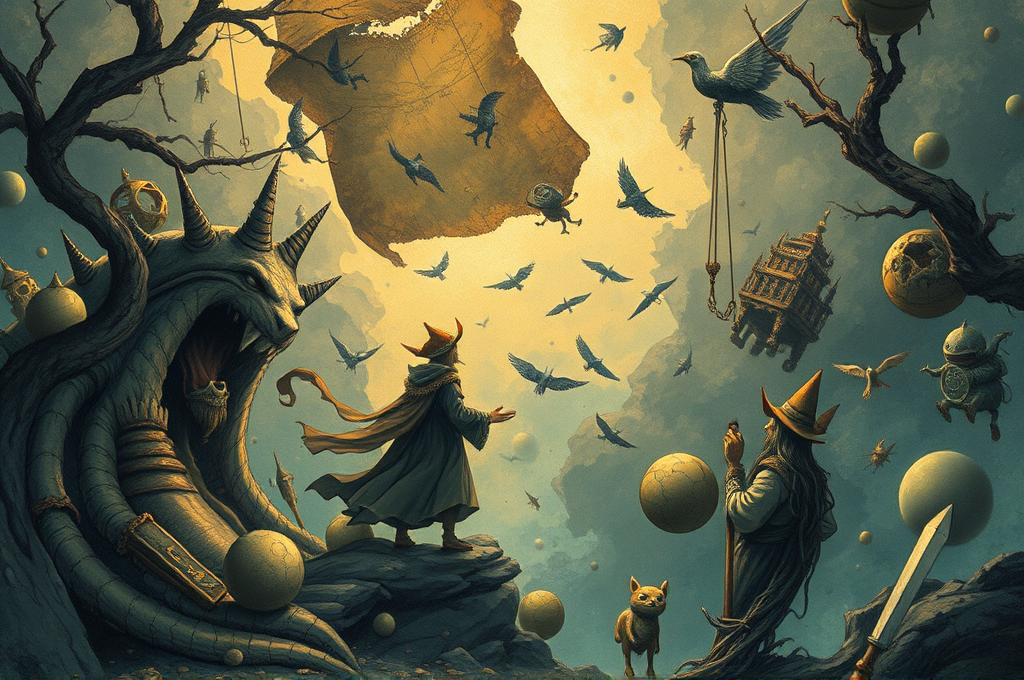
In *Attack on Titan*, the Walls are the source of every conflict. Safety inside the wall against freedom beyond it. The desire to know against the danger of knowing. This binary tension is a *structural* conflict embedded in the world's design — characters move according to the world's dynamics. The world comes first; characters move within its constraints. This structure is what gives a narrative its sense of inevitability.
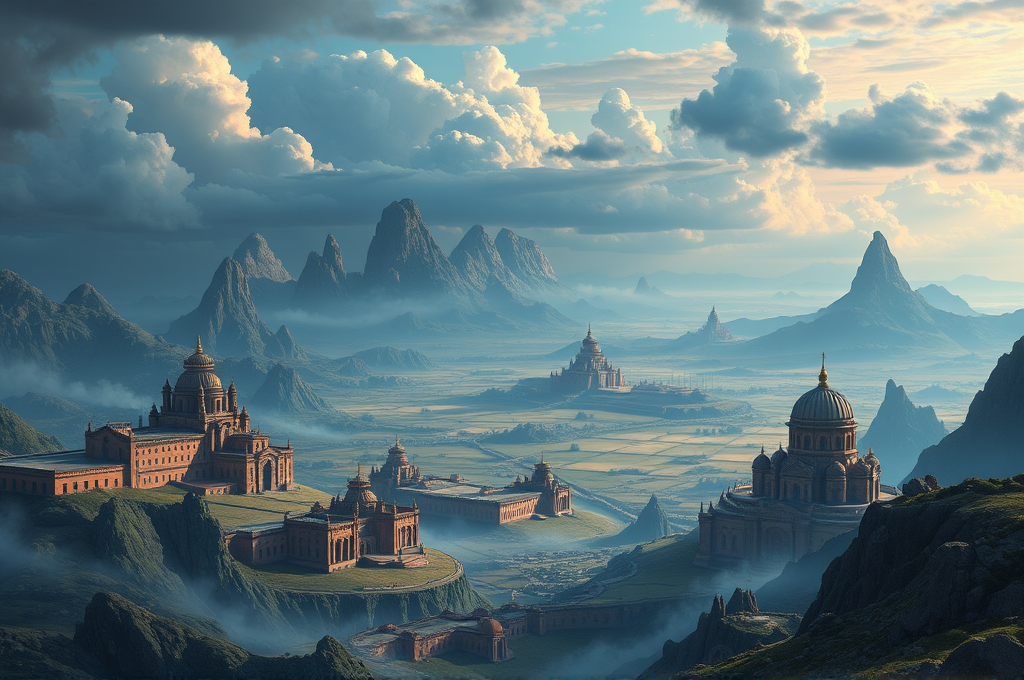
Similarly, in the demo world Aetheria, the physical separation between the Canopy Islands and the Root Land structurally generates a conflict of contact versus isolation. Sora's motivation to reach the Root Land is partly character personality and partly what the world's structure demands. When the world's constraints give characters natural motivation, story moves more organically.
The key to designing a world's constraints is giving them a historical context for why they arose. Constraints with reasons generate depth in the characters who are bound by them.
The Iceberg Principle: The Value of What You Don't Show
Hemingway's iceberg theory applies to world-building as directly as it applies to prose. You only need to show readers 10% of the whole. The other 90% stays beneath the surface. But that 90% must genuinely exist — because its presence is what gives the visible 10% its weight and credibility.
The sense that the first *Star Wars* trilogy's audience felt — of looking into a corner of a vast galaxy — came from George Lucas's established but mostly unspoken galactic history, political structure, and cultural depth. "The Clone Wars," "the fall of the Jedi," "the Old Republic" — each is only mentioned in fragments. But those fragments make audiences feel *there is vastly more history behind this*, and that feeling is what creates the sense of depth.
The same principle is at work in Aetheria. The Great Fall's backstory includes a note that it happened "once before, a thousand years ago." This single detail deepens the current crisis immeasurably. What happened in that era? Why could the two civilizations cooperate then? The unspoken 90% is what gives the present story its gravity.
Worldbuilding Determines the Depth of Emotional Investment
Strong world-building calibrates how deeply readers invest emotionally in characters. When a character makes a decision, how much that decision weighs depends entirely on the world around it.
"Destroying the wall" is the heaviest decision available to a reader who deeply understands what the wall means. "Attempting the seventh stage of refinement" is the most tense moment available to a reader who knows what Ether Refining risks. The deeper readers understand the world, the greater the weight of every character action.
This applies equally in film. The scene in *The Godfather* where Michael first acts as a member of the Family carries such weight because the preceding narrative has carefully built what "the Family" means. Worldbuilding sets the amplitude of drama.
Conversely, in a world with thin world-building, every decision feels lightweight. If readers don't understand why something matters, no emotional response can be coaxed from them. The depth of emotional investment is proportional to the thickness of the worldbuilding.
The Cost of Consistency Failure
Another dimension of worldbuilding's importance is the severity of the cost when it fails. In a precisely built world, even a single exposed contradiction can cause readers' trust to collapse suddenly.
Narrative immersion is like fine glasswork. When every detail is carefully made, readers can surrender to the story with confidence. But introduce a single crack and readers' attention shifts from the story to the contradiction. "That part didn't make sense" is an experience that damages trust in the entire work.
This is why consistency checking is an essential creative process. The contradiction-detection feature that Worldseed provides exists precisely to prevent this cost before it occurs.
A World Has Value Beyond Any Single Story
A sufficiently deep world carries value that exceeds any single story told within it. Tolkien's Middle-earth supported dozens of narratives, from *The Hobbit* to *The Silmarillion* and beyond. The Marvel Universe contains countless characters and storylines.
This is also narrative economics. Build one deep world and it generates infinite stories. Build a shallow world for a single story and the next story needs an entirely new world. Investment in world-building is a long-term asset that exceeds investment in any particular story.
Conclusion: Worldbuilding Is Narrative Infrastructure
Worldbuilding is not a hobbyist's indulgence — it is the infrastructure work that supports the fundamental quality of a story. Constraints generate conflict; consistency provides credibility; depth guarantees expandability. No great story emerges without strong worldbuilding.
Building worlds was once an enormously time-consuming undertaking. Creating a Middle-earth-scale setting as a single writer took decades.
Worldseed is a platform designed to make this infrastructure work — the deep, contradiction-free worldbuilding process — more efficient through AI dialogue. Start from a single idea. The experience of growing a world and spinning stories from it is waiting for you.
→ See worldbuilding in practice: explore Aetheria
Practice: Starting World-Building Today
The most common failure when beginning world-building is trying to write a complete setting document from the start. A setting document is for recording a world, not for creating one.
Worlds are born from questions. "Why does magic exist in this world?" "Who can use it, and who can't?" "How do non-magical people regard those who can?" One question calls forth the next, and the chain of questions grows the world.
In Worldseed, you can practice this process through AI dialogue. Starting from "tell me one idea," the AI asks questions that sketch the world's outlines. You don't need to write a perfect setting document. The world grows in the conversation.
Carry it into your world
Turn one idea from this article into a living part of your world
Name the world, choose a genre, and use AI to connect your first element to the rest of the setting.
This week's seed: “Magic works only when spoken aloud in front of a witness. Who becomes valuable in this world — and who is silenced?”
Free includes 20 AI messages per 24 hours. No card required.
Keep shaping the idea
Three guides connected by topic, craft, or worldbuilding method.
From Idea to Canon: One Place, Three Decisions
A practical worldbuilding loop for separating AI suggestions, your revisions, and the setting you actually keep. Use a night harbor example and a Keep/Change/Leave open worksheet to turn one idea into usable canon.
Read guide →When Messages Travel Faster Than Ships: An Alternate-History Consequence Ledger
A practical alternate-history exercise for tracing one changed technology into the organization that controls it, ordinary work and travel, and a scene a reader can witness. Includes a four-column consequence ledger.
Read guide →Make a Magic Rule Through One Dispute
A practical worldbuilding exercise for making a magic rule matter: give two claimants a dispute, choose who judges it, define the price of proof, and decide one allowed exception. Includes a blank dispute card.
Read guide →