SF Economy System Design Guide — Building a Credible Fictional Economy
How to design a believable economic system for a science fiction world: scarcity sources, currency foundations, trade dynamics, resource distribution philosophy, and the economics of automation.

"Who is doing what to survive in this world?"
A science fiction setting that can't answer this question feels hollow. Spaceships may fill the sky and aliens may walk the streets, but the fundamental economic question — how does this society deal with scarcity? — cannot be escaped. Designing a fictional economy means answering: what is scarce in this world, and how is it distributed?
Defining Your Source of Scarcity
In a real economy, scarcity is primarily defined by energy, land, labor, and time. Science fiction scenarios often resolve some of these constraints. Fusion power eliminates energy problems. Space colonization eases land pressure. Robotics changes the scarcity of human labor.
The crucial insight is that solving one scarcity reveals another.
Consider a world where energy is effectively unlimited. Manufacturing costs drop, material abundance improves dramatically. But now a new question emerges: if machines can make anything, what is human work for? "Meaningful work," "creativity," and "things only humans can do" become the new scarce resources.
Clearly identifying what your SF world's scarcity is built on is the foundation of economic system design.
What Does Currency Mean to Trust?
Currency is an exchange medium that everyone agrees to trust. The gold standard is trust in gold's scarcity. Modern fiat currency is trust in governments and states. Cryptocurrency is trust in mathematical algorithms.
When designing currency for your SF world, ask: *what trust makes this currency function?* A galactic empire's standard credit is backed by trust in the emperor's authority and military force. An independent frontier colony's local currency reflects trust in that colony's productive capacity and self-governance.
Multiple currencies create exchange rates and friction between them — which generates story. When imperial currency collapses in the borderlands, barter economies may revive. Certain rare materials — fuel cells, refined rare elements — may function as de facto currency in some colonies.
Aetheria's Ether Refining is an instructive example: refined ether crystals serve as a practical standard of value. When a technical product takes on monetary function, political conflict over that technology's monopoly becomes inevitable.
Trade Dynamics: Who Has What, Who Wants What
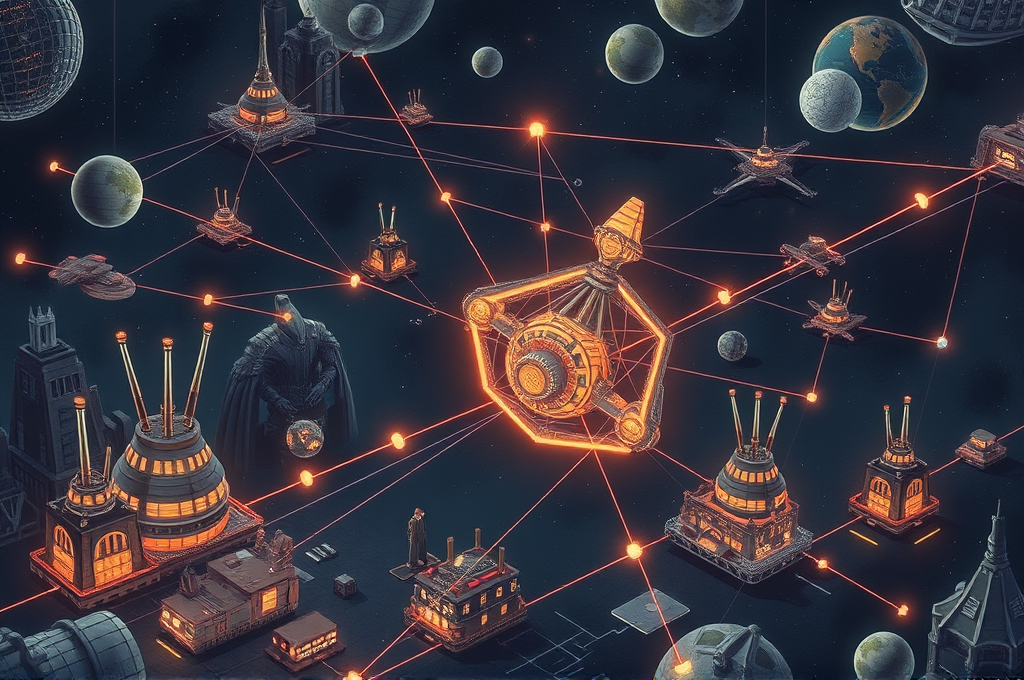
Trade exists because of comparative advantage. If Star System A excels at agricultural production and System B at precision manufacturing, both become wealthier by exchanging food for machinery. This principle holds in SF worlds just as firmly as in real economies.
Key factors to consider when designing trade routes:
Geographic constraints on production: Which systems or regions can produce what? Stellar composition, gravity, atmosphere, temperature — these determine outputs. Water-rich systems suit agriculture; heavy-metal asteroid belts suit mining.
Transport cost and danger: Distance, the presence of jump gates, piracy zones — transport difficulty creates price differentials. The same goods might cost three times as much on the frontier as in the imperial core.
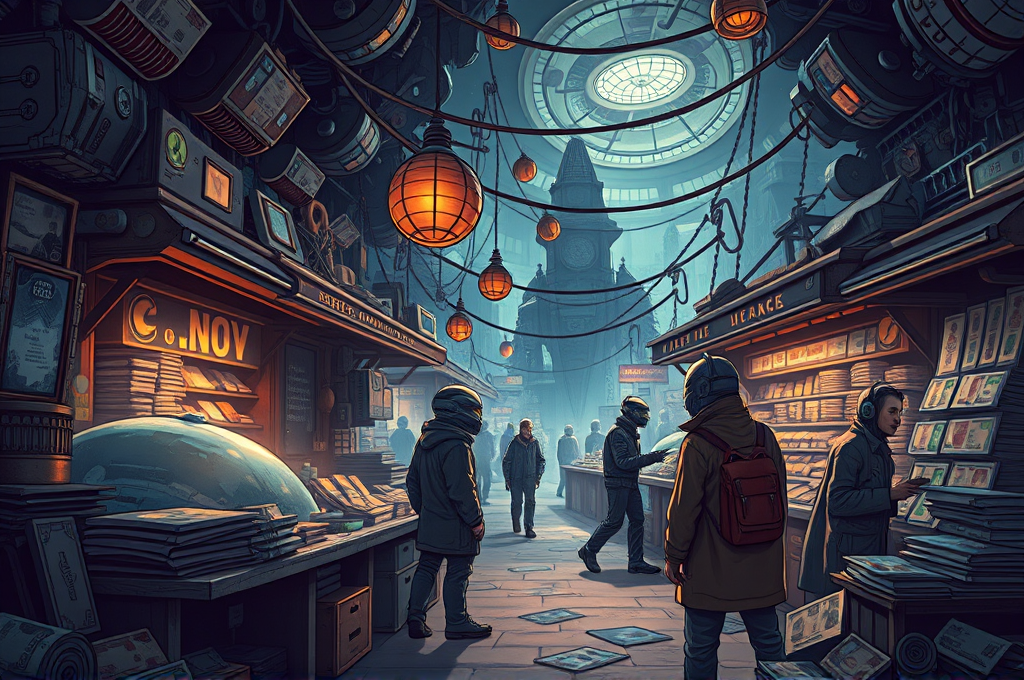
Information asymmetry: Merchants who know earliest where shortages exist earn profits. This is precisely why information brokers emerge as a viable profession.
Contraband and black markets: Wherever governments prohibit something, smuggling routes appear. The economics of contraband generates the underground's power structures.
The Philosophical Split in Resource Distribution
"Who owns resources, and who decides?" cannot be separated from political structure. Your world's economic system is a reflection of its political ideology.
Market system: Price mechanisms allocate resources. Efficient, but generates inequality.
Planned economy: Central authority determines allocation. More egalitarian but prone to inefficiency. AI-driven central planning could theoretically solve the classic calculation problem — a staple theme of hard SF.
Commons management: Certain resources (jump points in space, for example) are managed as shared property. The managing organization itself accrues power and becomes vulnerable to corruption.
Your world likely runs on one of these or a hybrid. And that choice determines the shape of your world's social tensions and political conflicts.
Economic Fault Lines Drive Story
Attributing a world's economic inequality to "a bad king" reduces your narrative to shallow moralizing. Structural economic inequality, by contrast, generates complexity and depth.
Imagine a corporate consortium that charges tolls on all jump gate transits, effectively controlling galactic trade. Technically legal, but their monopoly position creates a profound divide between have and have-not systems. From this single structure emerge: frontier rebel organizations fighting the system, middle-class merchants who profit but feel moral unease, reformists working for change from within. These characters don't require invention — the economic structure generates them naturally.
Designing Your Economy with Worldseed
Designing a fictional economy from scratch is a task where oversights are easy. "If I establish A in this world, does that create a contradiction with B?" — this kind of cross-checking is much more efficient as a dialogue than a solo exercise.
Worldseed lets you develop economic settings through AI conversation. Starting from "what is scarce in this world," you can build up the logic of currency, trade, and resource distribution one piece at a time, with AI flagging contradictions and filling gaps.
Energy Economics and the Shape of Civilization
Every civilization's economy is grounded in its system for obtaining, converting, and distributing energy. Ignoring this in SF worldbuilding leaves your economic design without a foundation.
Agricultural civilizations are constrained by efficiency in converting solar energy into food. Industrial civilizations place fossil fuel extraction and combustion at their economic core. Interstellar civilizations, with direct stellar energy use (Dyson spheres) or antimatter and fusion efficiency, face a different set of upper limits.
Which energy base does your SF civilization stand on? That answer determines the starting point for your world's technology level, population density, city scale, travel speed, and the character of warfare.
The Information Economy: When Knowledge Is the Scarce Resource
The more abundant physical resources become, the more information rises to the center of economic life. In an information-economy world, *who knows what* is the source of power.
Proprietary technical knowledge, market intelligence, encrypted communication channels, AI training data — these all function as new forms of "resource." Where information can be monopolized, knowledge brokers, hackers, and information operations agencies become economically and politically significant actors.
The difficulty of "owning" information (since it can be copied) alongside the problem of *authenticating* it (guaranteeing it's genuine) adds unique complexity to SF economic design. Does a blockchain-style authenticity mechanism exist, or does a central authority guarantee information integrity? That choice determines the political structure of the information economy.
Automation and the Meaning of Human Work
In a world where robots and AI handle labor, the very definition of "human work" changes from the ground up. This transformation becomes the central problem of economic design.
In a fully automated world, distributing the products of production becomes a purely political problem — the traditional justification for distribution based on "contribution to production" disappears. Basic income-style distribution? Ownership-based distribution of the means of production? Meritocratic distribution? The choice shapes the class structure and political ideology of the automated age.
The changing value of work that *cannot* be automated matters too. Tasks requiring human emotion, intuition, creativity, and ethical judgment become increasingly scarce as automation advances — and economically more valuable. Artists, counselors, religious leaders, ethics committee members — a SF world where these professions hold high social status has a completely inverted occupational value hierarchy compared to our own.
Carry it into your world
Turn one idea from this article into a living part of your world
Name the world, choose a genre, and use AI to connect your first element to the rest of the setting.
This week's seed: “Magic works only when spoken aloud in front of a witness. Who becomes valuable in this world — and who is silenced?”
Free includes 20 AI messages per 24 hours. No card required.
Keep shaping the idea
Three guides connected by topic, craft, or worldbuilding method.
Three Stories Behind a Settlement Name
A practical worldbuilding exercise for giving one settlement three useful names: the terrain name, the ruler's official name, and the short name residents actually say. Includes a blank worksheet.
Read guide →A Faction That Outlives Its Founder
A practical worldbuilding exercise for making an organization continue after its founder is gone: define the work, shared resource, succession choice, and internal conflict. Includes a blank organization card.
Read guide →From Idea to Canon: One Place, Three Decisions
A practical worldbuilding loop for separating AI suggestions, your revisions, and the setting you actually keep. Use a night harbor example and a Keep/Change/Leave open worksheet to turn one idea into usable canon.
Read guide →