Design Notes: Building the Demo World 'Aetheria'
An explanation of the design philosophy behind Worldseed's demo world Aetheria — how a single contrast generates an entire world, the role of technology as cultural philosophy, the third faction, the Great Fall as a ticking clock, and character placement.
Introduction
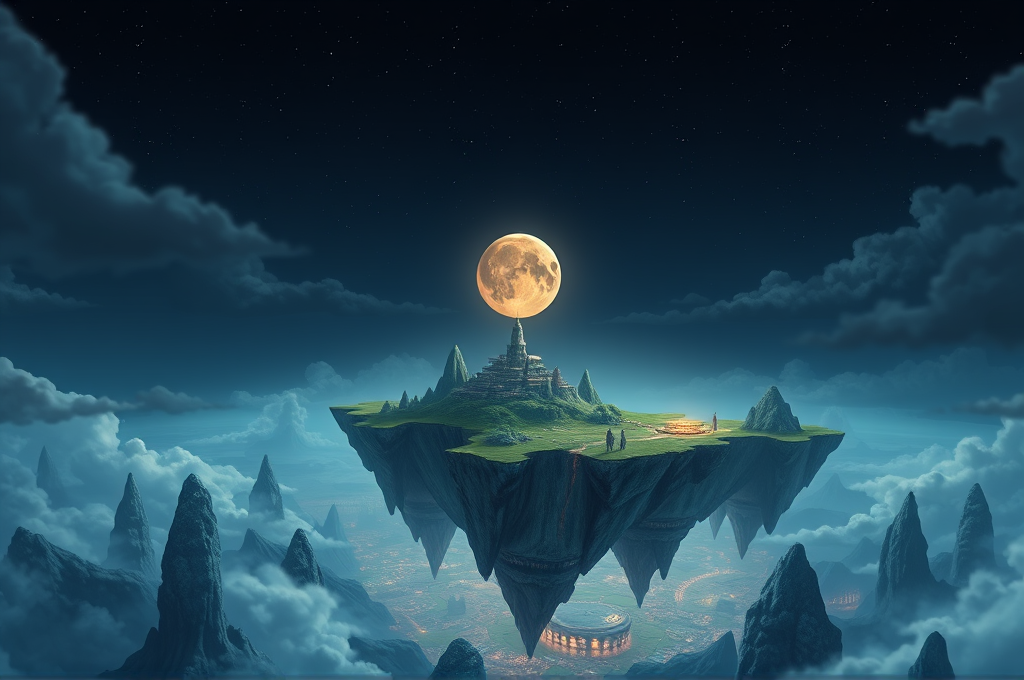
This piece explains the design philosophy behind Worldseed's demo world, "Aetheria — Between Sky and Earth." It is intended as a practical reference for your own world-building. Aetheria is one answer to the question "how do you turn a concept into a concrete world?" By making the design process transparent, it shows both how Worldseed works and how worldbuilding itself works.
Starting Point: One Contrast
Aetheria began with a single contrast: *sky versus earth*. Floating cities against underground civilization. Light against bioluminescence. Ascent against rootedness. Extending this contrast to the level of whole civilizations is Aetheria's skeleton.
The core worldbuilding principle is to establish one strong contrast first, then derive everything else from it. In Aetheria:
- Sky (Canopy Islands) ↔ Earth (Root Land)
- Ether Stone (lift) ↔ Earth Memory (gravity)
- Parliamentary guild rule (oligarchy) ↔ Mycelium voting (direct democracy)
- Light ↔ Bioluminescence
- Individual excellence ↔ Collective intelligence
Everything is a variation on "sky vs. earth." This consistency gives the world its coherence.
Once the first contrast is established, ask three questions: "How does this contrast appear physically?" "How does it appear socially?" "What kind of interior does a person entangled in this contrast have?" Repeating these three questions is how one contrast spreads across an entire world.
The World's Core: Ether Stone and Earth Memory
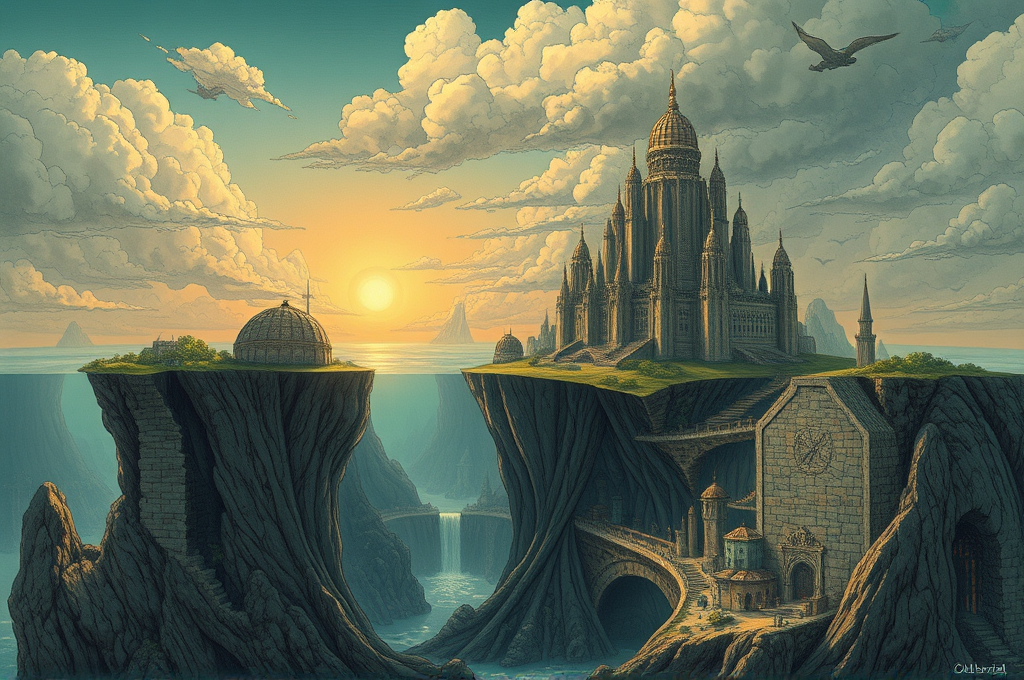
The "technologies" supporting Aetheria's two civilizations embody the world's philosophy.
Ether Stone is the foundation of the Canopy Islands. Gravity-defying crystals are the material embodiment of the Canopy Islanders' values — ascent, excellence, individual achievement. Ether Refining, in which refiners purify Ether Stone through seven stages, is both a technical system and a metaphor for the Canopy Islands' values: "the higher you reach, the greater the danger."
The Root Land's mycelial network (Earth Memory), by contrast, is an emotional transmission network threaded through the underground. The Root Land's people share each other's emotions through this network and make collective decisions through "mycelium voting." The value system that prizes collective intelligence over individual excellence functions as civilizational infrastructure.
The fact that these two "technologies" are not mere tools but embodiments of civilizational philosophy is deliberate design. Technology reflects culture; culture is shaped by technology. This cycle is what gives the world its thickness.
Positioning the Third Faction
Two-way opposition alone makes a story flat. So I placed the Shimobe as "a third faction that belongs to neither side."
The Shimobe are winged people who inhabit the mid-air space between sky and earth. They function as intermediaries, smugglers, and observers for both civilizations, adding complexity to the story. With the Shimobe present, the story is not a simple sky-versus-earth opposition but a political drama where the interests of three parties are entangled.
The key point when designing a third faction is clarifying the *reason they don't take sides*. The Shimobe's neutrality is not moral but economic — the continuation of the conflict between both civilizations is what sustains the Shimobe's intermediary business. This "neutrality through self-interest" makes the Shimobe not a simple "well-meaning mediator" but an entity with complex motivation.
The Great Fall as Ticking Clock
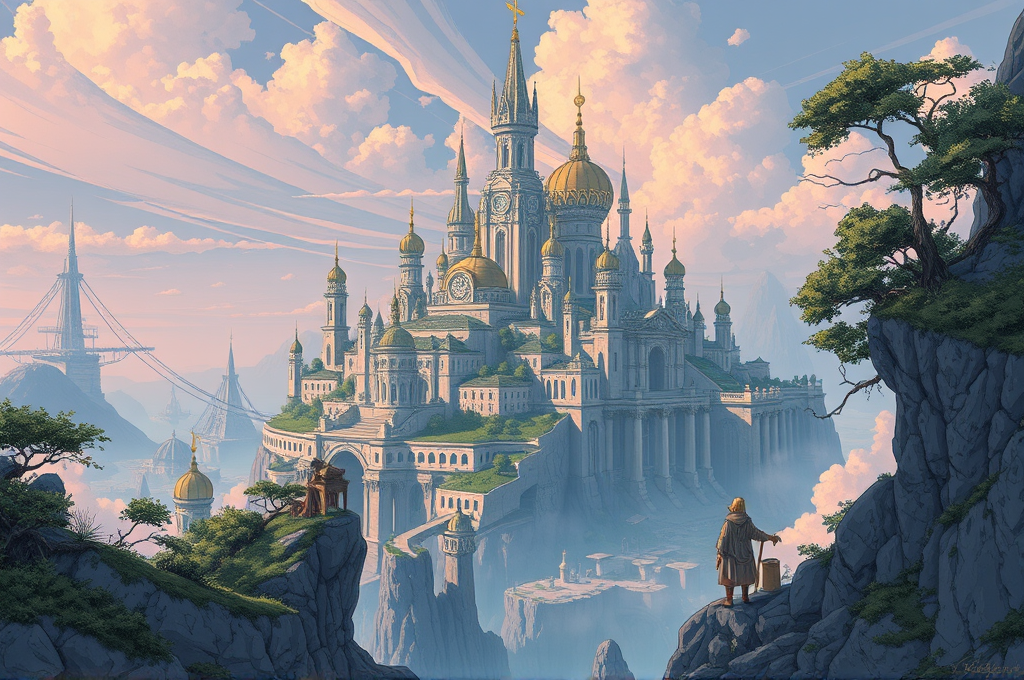
In world-building, one of the most important elements is the *trigger* — "why does the story start moving now?" In Aetheria, the Great Fall — the thousand-year cycle of Ether Stone losing its buoyancy — is that trigger.
The Great Fall's preconditions are set in three stages (lower fog, reverse rain, mycelium silence) to give the story the tension of a time limit. The first two signs have already been observed, meaning: "find a solution before the third sign arrives." This creates pressure.
The critical design question for any ticking clock is: "why hasn't this been solved before?" The Great Fall is once-in-a-millennium — no one alive has experienced it before. The solution used in the past exists only as fragmentary records. This setting answers the legitimate question "if it was solved last time, why is this time harder?"
And the detail that the previous solution required cooperation between the Canopy Islands and the Root Land raises the tragedy of the current disconnection. "These peoples who once cooperated — why do they no longer know each other?" That mystery itself becomes a story motivation.
The Triangle of Character Placement
The four main characters are positioned to reflect the world's structure:
- Sora (Canopy Islands, lower tier): Positioned at the boundary between sky and earth, with the motivation to connect both
- Tsuchi (Root Land): Holds the memory of the past and the key to the solution
- Hane (Shimobe): The intermediary who connects the other two
- Ishinocho (Canopy Islands, upper tier): The obstacle who prefers the status quo
This placement automatically derives the story's mechanics — who cooperates with whom, and who becomes an obstacle — from the world's structure. Deriving characters from the world's structure is what generates the *inevitability* of "why is this character here?"
What I was particularly careful about in character design was their function as "embodiments of the world-view." Sora, as a person from the lower tier of the Canopy Islands, can perceive contradictions in the world that the elite cannot see. Tsuchi, as an entity with access to the mycelial network's depths, carries the memory of history. Each embodies a different aspect of the world, and the world is described multidimensionally as the characters move.
The Practice of Design: Growing a World Through AI Dialogue
The part of Aetheria's design process that took the most time was the consistency checking for each element. Does Ether Stone's physical property not contradict the Canopy Islands' architectural style? Does the mycelial network's emotional sharing connect logically to the Root Land's culture? Does the Great Fall's mechanism align with the established physical laws?
In Worldseed, AI supports this kind of consistency checking. "Does this setting contradict that one?" "If this element has this social impact, something else in the world should change" — receiving this kind of feedback while growing the world in a contradiction-free direction is exactly what the platform enables.
Aetheria is published not as a finished world but as a "world still growing, ready to explore." Reading through each element's page reveals the details of the design and the foreshadowing of the story.
Why Not Build Your Own?
Aetheria is a demo world built with Worldseed. Would you like to grow your own unique world using the same tools? Through AI dialogue, a rich world can take root from a single idea.
Exploring Aetheria's individual elements gives you a concrete image of what worldbuilding looks like in practice:
- Canopy Islands — Details of the floating civilization
- Root Land — Underground civilization and the mycelial network
- Ether Refining — A magic system design example
- Great Fall — The world's ticking clock
Carry it into your world
Turn one idea from this article into a living part of your world
Name the world, choose a genre, and use AI to connect your first element to the rest of the setting.
This week's seed: “Magic works only when spoken aloud in front of a witness. Who becomes valuable in this world — and who is silenced?”
Free includes 20 AI messages per 24 hours. No card required.
Keep shaping the idea
Three guides connected by topic, craft, or worldbuilding method.
I Built a World with Worldseed — An AI-Assisted Worldbuilding Experience
A firsthand account of building a fictional world through AI dialogue in Worldseed: how questions deepen a world, comparing with the Aetheria demo, and what AI is good and not good at.
Read guide →Three Stories Behind a Settlement Name
A practical worldbuilding exercise for giving one settlement three useful names: the terrain name, the ruler's official name, and the short name residents actually say. Includes a blank worksheet.
Read guide →A Faction That Outlives Its Founder
A practical worldbuilding exercise for making an organization continue after its founder is gone: define the work, shared resource, succession choice, and internal conflict. Includes a blank organization card.
Read guide →